The Swing Shift Shuffle is a radio program of swing, big band, jazz, boogie woogie and other popular music from the 1930's and 40's that airs every Wednesday from 6:00 to 8:00 p.m. (US Central Time) on WEVL 89.9 FM in Memphis, Tennessee, with a live webcast at wevl.org. In addition to the radio show, this blog is dedicated to all aspects of the Swing Era, including art, automobiles, cartoons, comics, history, movies, music, news, science, technology, and anything else that happened during that time. It also includes announcements about events in the Memphis/Mid-South area related to the Swing Era, such as classic movies, concerts, dances, lectures, etc. If you see something that fits the description, send it to me at tim@wevl.org. If you would like more information about the radio show, just go to the Radio Show FAQ page.
Showing posts with label Science and Technology. Show all posts

Monday, March 5, 2018

U.S Navy's Flying Aircraft Carrier


Here is a post from Vintage Everyday with a series of photographs of the USS Macon, a 1930's U.S. Navy dirigible designed to serve as a flying aircraft carrier.  The airship could launch and retrieve biplane fighters in mid-air. Airships were difficult to handle in strong weather, and the Macon, along with 3 other of its sister ships, crashed. 

Monday, January 29, 2018

Documentary Of Hedy Lamar

Hedy
I'm a little late in posting about this, but better late than never.  Bombshell:  The Hedy Lamarr Story is a recent documentary about Hollywood legend Hedy Lamarr.  Unknown to most, in addition to being considered the most beautiful woman to ever appear on the screen, Ms. Lamarr was responsible for inventing and patenting technology that became the basis for cell phone, wifi and Bluetooth.  This film tells that story. 

Thursday, January 11, 2018

Depression Era Industrial Film


As Boing Boing noted in this post, before robots did the work, machine parts used to be made by people.  This 1936 film shows workers machining precision components.  If you are a fan of industrial machinery, you should get a kick out of this film.

Thursday, December 14, 2017

80 Year Old Bluebird Returns To The Water


In 1937, Sir Malcolm Campbell set a new world water speed record of 129.50 mph in his Bluebird K3 hydroplane, and the following year, he broke the 130 mph mark at 130.91 mph with the same boat.  Hemmings Motor News reported that now, 80 years after the vessel's last record, it has returned to the water.  After a 20-year-long restoration by current owner Karl Foulkes-Halbard, the Bluebird K3 managed a speed of 52 mph in a test on Bewl Water in Kent, U.K., in early September in Kent, U.K.

Tuesday, November 21, 2017

Finds: 1940s RCA VIctrola Wireless Record Player

I'm adding a new series to the blog:  Finds.  Occasionally, I get the chance to hit the odd antique store, estate sale or flea market.  Whether I buy anything or not, I often see some pretty interesting items from the Swing Era, and I often learn something new when I do.  Case in point:  this 1940 RCA Victrola Wireless Record Player I found last month at the Nashville Flea Market.  Yes, you read that correctly - "Wireless" record player.  This unit has no speakers, and other than a power cord, no cables or cords to connect it to any other device.  How do you hear the music?  This device sends the audio from the record, via its own internal radio transmitter, to any nearby AM radio tuned to that frequency.  Yes, well before Bluetooth and Mr. Microphone, folks could hear their music transmitted wirelessly from one device to another.  Prior to finding this item, I had no clue that such things existed.  Apparently they were manufactured by several companies from 1939 to 1942.  
 
P.S. - If you're wondering what happened to it, I bought it on behalf of a friend of mine who restores antique radios.  Of course, he knew exactly what it was, and it has found a good home. 

Thursday, June 29, 2017

Only Axis Attack On Continental U.S.


The National World War II Museum posted this items about the only Axis attack on the continental U.S. during WWII. 
On June 21, 1942 Civil-War era Fort Stevens, near the mouth of the Columbia River in Oregon, was shelled by Japanese forces. The Japanese submarine I-25, with a crew of 97, and armed with a 14 cm deck gun and carrying a seaplane, opened fire. Fort Stevens commander ordered an immediate blackout, and held all fire. This prevented the submarine from accurately targeting the base. Of the seventeen shots, the only damage was to some telephone poles near the base–the remainder landed on a baseball field or a nearby wetland. Just past the battery of Fort Stevens was the northern Kaiser shipyard, which was at that time turning out a Liberty Ship each week.
The notion of a submarine carrying an airplane seems a little like science fiction, even today.  I believe I have seen the idea in some comic books of the era, but the Japanese deployed such a vessel.  The aircraft from I-25 dropped incendiary bombs on the northwest U.S. after the above encounter, but rains and the U.S. Forest Service prevented any noticeable damage.

Monday, December 19, 2016

1938 French "Walkman"

Paleofuture posted this excerpt from an article in the May 1938 issue of Short Wave and Television, which featured the latest developments in radio from Paris.  Considering the limitations of technology at the time, the "portable" radio at left was pretty compact in its day. 

Monday, November 7, 2016

House Of Tomorrow Gains National Treasure Status

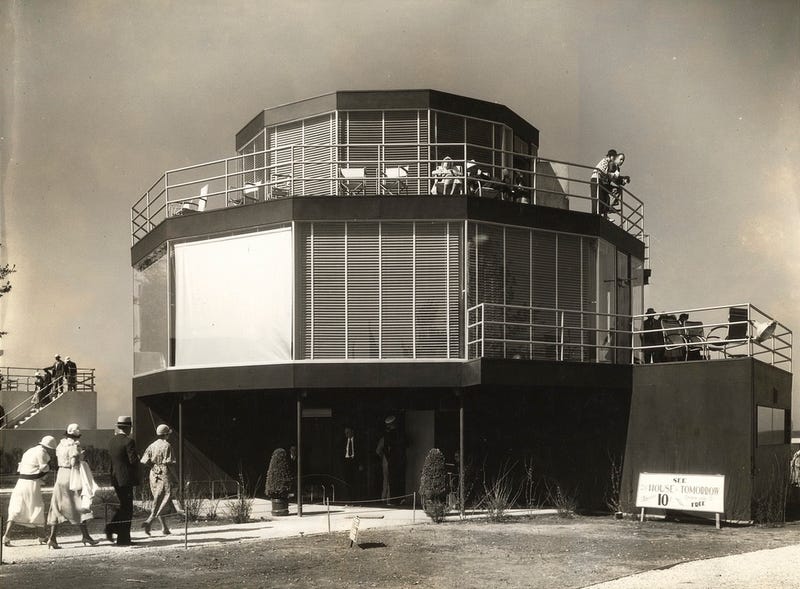
Paleofuture informs us that the National Register for Historic Preservation has declared the "House of Tomorrow" - an exhibit from the 1933 Chicago World's Fair - to be a National Treasure, and the Indiana Landmarks Commission is undertaking to raise $2 million to preserve it.  Although part of the 1933 Chicago World's Fair, the house was actually located in Indiana, where it still drew thousands of visitors. 

The house had everything from an attached garage that could move up and down at the push of a button to central air conditioning. It even had an airplane hangar. The car that was often parked out front was “streamlined” in the ultra modern style of 1930s futurism.
Remember those early Warner Bros. cartoons about a couple of dogs getting trapped in a "Home of the Future" display?  This house was probably the inspiration. 

Wednesday, October 26, 2016

From Radar To Microwave Ovens

A Raytheon Radarange from the 1950s The National World War II Museum blog posted this item regarding the origin of the microwave oven.  From it we learn that while American scientist Percy Spencer was experimenting with magnetrons one day in 1940, he discovered that the candy bar in his pocket melted.  The next day, he placed a container of popcorn over the magnetron, and became the first person to make microwave popcorn.

Monday, October 17, 2016

The Future Of Bicycles


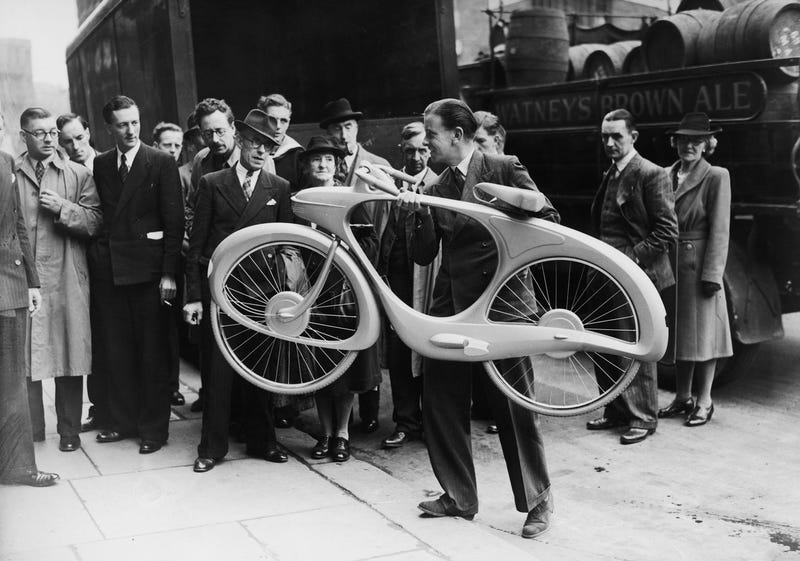
Benjamin Bowden demonstrates the lightweight nature of his bicycle design in 1946.  The accompanying article, posted on Paleofuture, notes that the design was intended to represent what bicycles would look like 20 years in the future, at least from a 1946 perspective.  Although it did go into production, not until 1960, and by then it was outdated and expensive.  The few that were produced are very collectible.

Wednesday, August 17, 2016

Silly Putty's WW2 Origins


The title of this post on the National World War II Museum site may be slightly misleading, in that it led me to think that Silly Putty was both invented during WW2, and served some purpose during the war effort.  Stranger things have happened.  Only the latter is accurate.  Like many other great inventions, Silly Putty was an accident:  a failed attempt to create artificial rubber (certainly useful to the war effort) that bounced when accidentally dropped, so meriting a patent.  The rest is history.

Monday, August 8, 2016

Television Is Coming

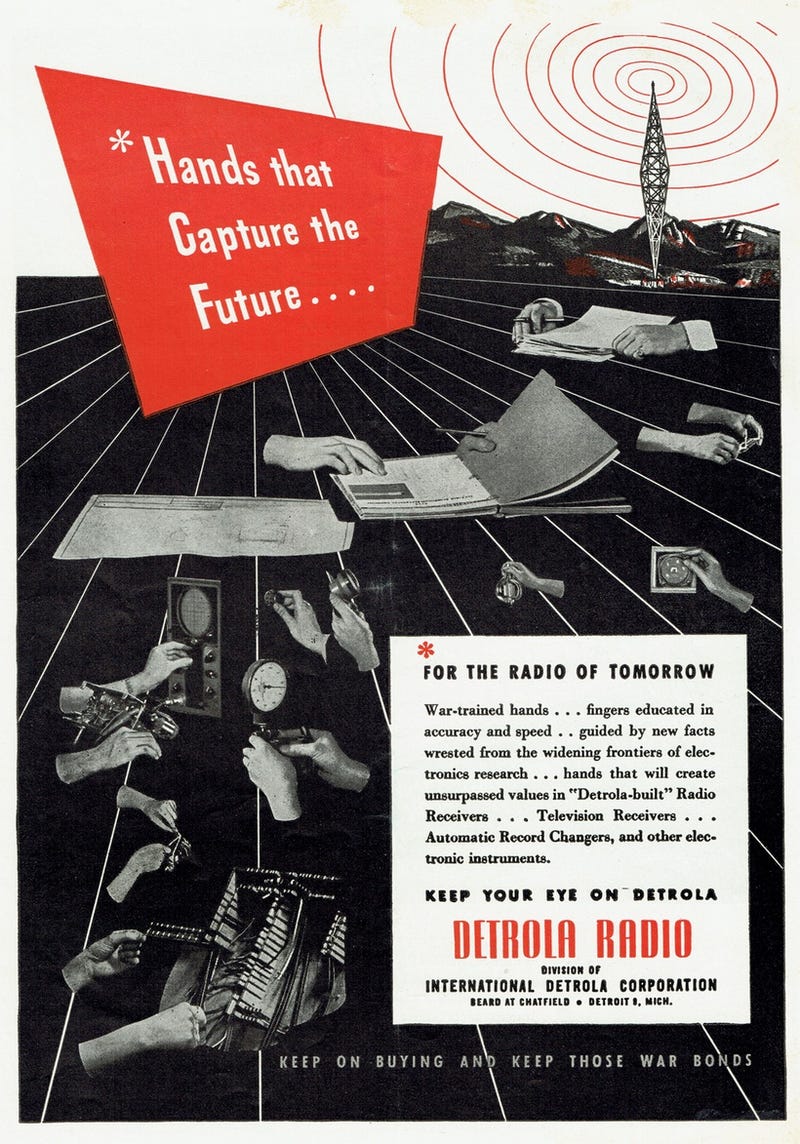
Being in the advertising industry during World War II must have been a surreal experience, especially if your clients were manufacturers of durable goods.  All large scale production was under government contract cranking out the arsenal of democracy, and nobody had anything to sell to the general public, so what did one advertise?  The promise of a brighter tomorrow.  Paleofuture posted this 1945 ad from Detrola Radio, with hints of the newest gadget, television. 

Wednesday, July 13, 2016

1930's French Pharmacutical Ads

medical-ads-old
Nothing like a little French Art Deco pharmaceutical advertising to make things interesting.  Boing Boing posted this series of 1930's French drug ads.


Monday, June 6, 2016

The Strange Tanks Of D-Day

(Credit: Getty Images)
Today is the 72nd anniversary of the Allied landings in Normandy during World War II, a/k/a "D-Day."  The BBC has an interesting article on some of the unusual equipment that went ashore that day, and the inventive man behind them.  Although I was aware of Sherman tanks modified to "swim" or clear land mines, I did not know that they, along with some other tank variations, originated out of the mind of one man. 

Wednesday, April 6, 2016

NASA Still Flying 1940's British Bombers

(Credit: Getty Images)
Back in July, I posted an item from the BBC about a 1936 German sailing ship that is still in service with the U.S. Coast Guard.  Continuing that theme, the BBC has posted another "U.S. Government using old-European technology" article.  This instance, however, is on the other end of the technological spectrum from a sailing ship.  NASA still maintains and files three Canberras, a design that was commissioned and designed at the end of World War II, and first flew in 1950. 
Nasa’s Canberras are a part of the agency’s Airborne Science Program (ASP), explains Charles Mallini, who is the program manager for Nasa’s Canberra fleet. “The ASP is responsible for providing aircraft systems that further science and advance the use of satellite data,” he says.
. . . .
That Canberras are still flying is a tribute to the aircraft’s design, which is all the more impressive given that the Canberra is from the very first generation of jet aircraft – a time when aircraft designers were struggling to deal with the enormous issues that came from travelling at such high speeds. And it’s even more exceptional because the Canberras are doing a job that was undreamed of when the aircraft first entered service.

Thursday, March 10, 2016

Chrysler Arsenal Of Democracy


I saw the subject of this post in the actual print version of Hemmings Motor News (yes, people still occasionally read print publications).  It directed me to the Chrysler Arsenal of Democracy video, a documentary about Chrysler's contribution to the war effort during World War II, including its production of the M3 Grant and M4 Sherman tanks. 

Wednesday, March 9, 2016

Computers In World War II


As this post on the National World War II Museum blog points out, there are some who think of computers as relatively modern, digital electronic devices.  The post explains that computers, some of which were mechanical, were in wide use during World War II, from calculating air speed and firing ranges to breaking codes.  On that note, Turing's Bombe (pictured) is probably the most famous computer of the era.

Wednesday, December 16, 2015

Birth Of The Slinky

The National World War II Museum posted this example of serendipity.  In 1943, a Naval engineer named Richard James was trying to develop new kinds of springs to protect sensitive equipment from motion while at sea.  One of the experimental springs fell off a shelf or table, and "walked" down a series of surfaces.  Named by Mrs. James, the Slinky was born, and the rest is history.  During the holiday season of 1945, the Gimbels department store let the couple demonstrate the toy.  All 400 of the very first units were sold in thirty minutes. 

Thursday, November 19, 2015

Bacon Grease For Freedom


bacon fatBack in World War II, conserving resources and recycling was a big deal.  Rubber, paper and metal were all in high demand for recycling into products for the war effort.  The National World War II Museum posted this item about another highly sought after household product at the time:  bacon grease.  Fat from meats was recycled into explosives, so people saved their waste fat, put it in a can, and sent to make munitions. 

Monday, November 9, 2015

Happy 101st Hedy Lamarr


Vintage Ads posted this 1945 Maybelline advertisement featuring Hedy Lamarr, noting that today would have been her 101st birthday.  The Google doodle today was also in celebration of Ms. Lamarr, complete with a quick video that references her scientific, as well as acting accomplishments.  The scientific achievements include an improvement on traffic signals, a carbonated beverage pill, and most significantly, a radio frequency hopping system that is the basis for today's cell phone and wifi technology.